
What to Look for When Buying a Luxury Knit Sweater (And What to Avoid)
There is a moment everyone experiences when they first hold a genuinely well-made sweater: a particular quality to the weight, the drape, the way the fabric moves between your fingers. It does not feel like a sweater. It feels like a decision you will never regret.
Then there is the other kind: the sweater that looks similar in the photograph, costs considerably less, and pills after its third wash. The difference between them is not marketing. It is fibre, gauge, and construction : things you can learn to identify before you buy.
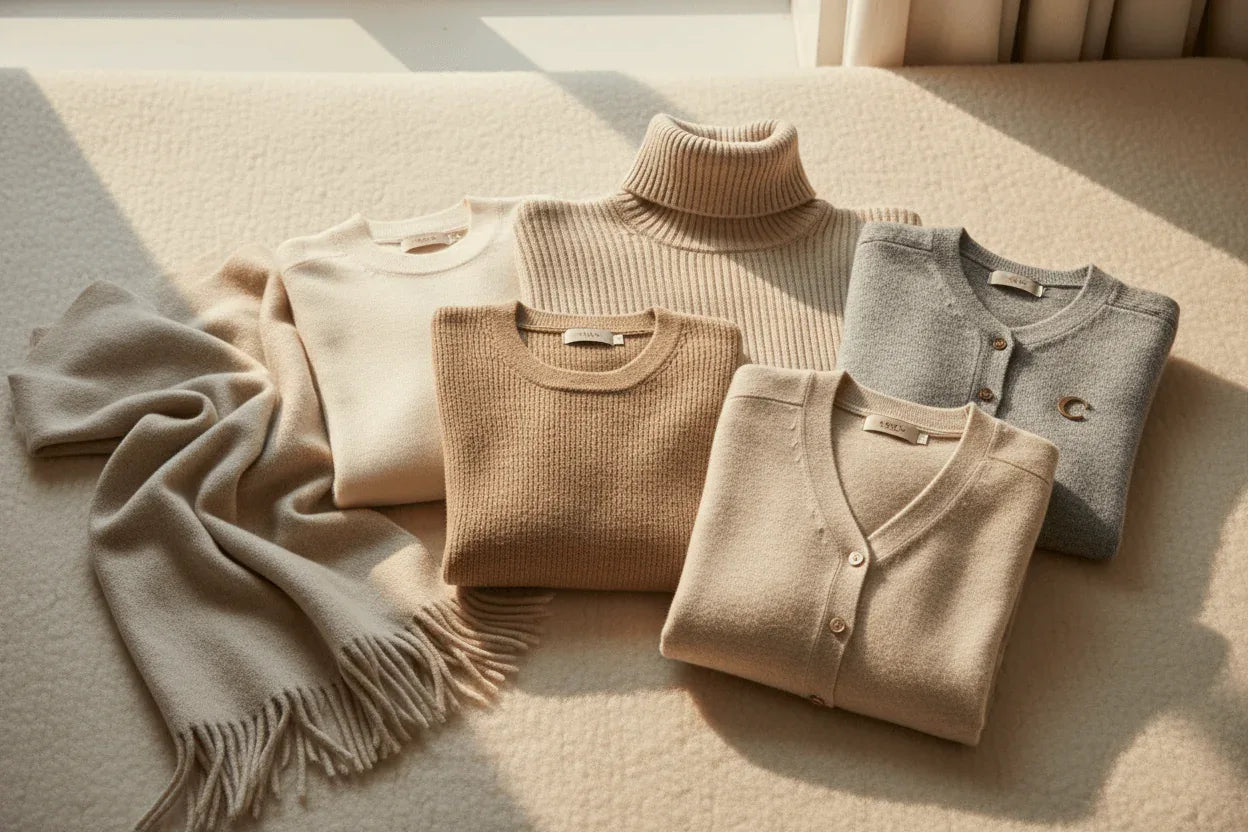
Featured from this guide
Shop the knitwear.
Start With the Fibre
The single most important factor in a sweater's quality is what it is made from. The care label tells you everything.
The natural fibre hierarchy
- Cashmere: the finest, softest, and most temperature-regulating natural fibre. Genuinely warm without being heavy. Look for a ply of at least 2 (2-ply cashmere is more durable and pills less).
- Merino wool: the most versatile premium fibre. Soft enough to wear against bare skin, temperature-regulating, naturally moisture-wicking, and significantly more durable than cashmere. Extra-fine merino (under 18.5µm) is the benchmark for quality.
- Alpaca: exceptionally soft, hypoallergenic, and warm. Baby alpaca (from the first shearing) is the finest grade.
- Lambswool: the first shearing from a young sheep, producing a softer, finer fibre than standard wool.
- Cotton and linen blends: for spring and summer knitwear. Natural, breathable, excellent in fine-gauge constructions.
What to avoid
- High acrylic content: pills quickly, retains odour, lacks the drape of natural fibres.
- Polyester as a primary fibre: similar issues to acrylic.
- Blends over 30% synthetic: read the percentages, not the marketing.
Understand Gauge
- Fine gauge (14–28 stitches per inch) : lightweight, smooth, and elegant. Most luxury knitwear is fine-gauge. It looks expensive because the construction is more labour-intensive.
- Mid gauge (7–12 stitches per inch) : the most versatile range. Classic crewnecks, cable knits, everyday sweaters.
- Chunky gauge (1–6 stitches per inch) : deliberately casual and textural. Quality assessed by fibre content and evenness of knit.
Examine the Construction
Seams
A quality sweater will have neat, flat seams: either fully fashioned (pieces shaped and then joined) or seamless construction. Avoid sweaters where seam allowance is bulky or fraying.
Neckline and ribbing
The neckline ribbing should lie flat and return to its original shape after being stretched. If it stays stretched or curls inward immediately, the tension is poor.
The hand-feel test
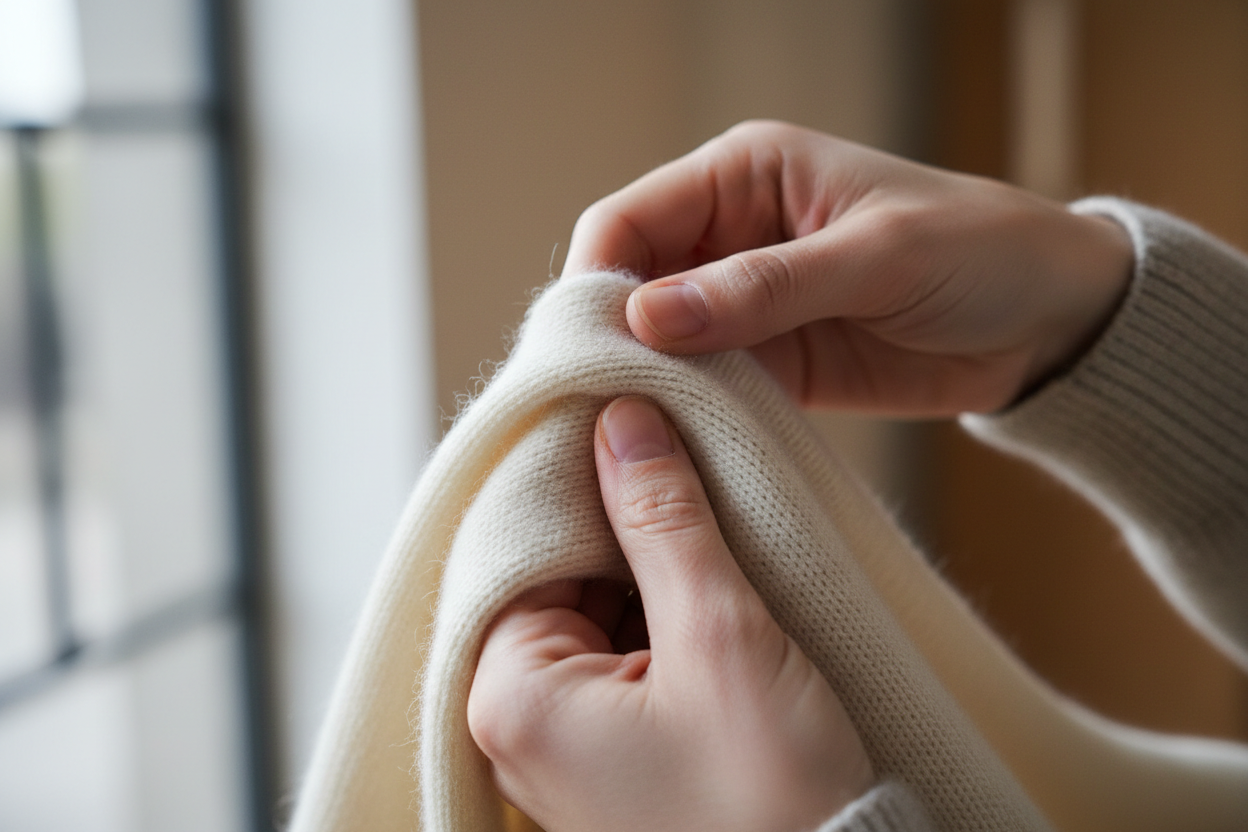
Quality natural fibre knitwear has a slight warmth and softness that synthetic fibre cannot replicate. It feels like it is doing something: insulating, breathing, responding to your body temperature.
Even stitch tension
The stitches should be even throughout: no loops visibly larger or tighter than their neighbours. Uneven tension predicts where the sweater will stretch out or distort with wear.
What Pilling Tells You
High-quality natural fibre knitwear: especially long-staple merino and tightly spun cashmere: pills minimally and settles after a few washes. Cheap acrylic knitwear pills aggressively and permanently. If a sweater pills heavily after one or two wears, the fibre content is likely low-quality regardless of what the label claims.
The Cost-Per-Wear Argument
A premium merino crewneck at £140, worn once a week for four years, costs £0.67 per wear. A £28 high-street equivalent, worn 15 times before it pills and stretches, costs £1.87 per wear: nearly three times as much, and it needs replacing. Luxury knitwear is not an indulgence. It is the economically rational choice.
Explore the ELNOVÉ collection
Shop SweatersKnow Your Knit Construction Types
Understanding construction types matters as much as knowing the fibre content. The knit pattern affects how the garment drapes, insulates, and wears over time.
Cable knit
Twisted rope-like columns of stitches crossing over one another. Cable knit construction creates a thick, structured fabric with natural insulation trapped in the twisted columns. A well-made cable sweater has even cable spacing with no dropped stitches at the twist points. The texture should be consistent from shoulder to hem. Cable knit construction also makes the garment noticeably heavier and warmer than a comparable flat-knit piece at the same fibre weight.
Waffle knit
A grid of raised squares created by alternating knit and purl stitches. The waffle pattern traps pockets of air between the fibre layers, which makes waffle-knit garments significantly warmer than their lightweight appearance suggests. Good waffle construction has uniform, even squares across the whole surface. Compressed or uneven waffle squares indicate low-tension knitting that will lose its grid structure after washing. For a detailed comparison of waffle and ribbed constructions, see our waffle knit vs ribbed knit guide.
Pointelle and openwork
Delicate eyelet patterns created by deliberately transferred stitches. These are fine-gauge constructions designed for lighter layering rather than insulation. Pointelle uses a small, repeating eyelet; openwork uses larger, more architectural lattice patterns. Both should have clean, consistent hole placement with no dropped or laddering stitches around the eyelets. Fine-gauge pointelle in natural fibre is among the more technically demanding constructions to produce, which is reflected in the price point of well-made examples.
Ribbed knit
Alternating columns of knit and purl stitches that create a stretchy, self-striped fabric. Ribbing is most often used at cuffs, hems, and necklines to create recovery and structure. A piece that is fully ribbed throughout has a firm, textured surface that holds its shape well. Good ribbing returns to its original width after stretching. Poor ribbing stays stretched and loses its elasticity within a season of regular wear.
Knowing these constructions helps you assess whether what you see in a product photograph matches what you read in the description. A waffle-knit pullover photographed flat should show a visible grid texture across the entire garment. An openwork knit top should have visible open areas in the knit. If the photograph and the construction description do not align, the product information is inaccurate or the product is not what it claims to be.
How to Evaluate Knitwear Online
Shopping knitwear online removes the hand-feel test, which is the most reliable quality signal available in a store. These four checks compensate for that loss.
Photograph detail
A brand confident in its fabric quality will show it close up. Look for detail shots that show the texture of the knit surface at high resolution. A flat-lay or single hanging shot is not enough information. Model close-ups showing how the fabric drapes and moves around the body give better data than a single front-facing image. If only styled campaign shots are available and no close-up fabric detail exists, the brand may be deliberately obscuring the construction quality.
Fibre content and care label
The care label is the most honest description the garment has. "Hand wash cold" or "delicate cycle" indicates natural fibre content. "Machine wash warm" on a fine-knit item usually means a high synthetic content. Fully natural fibre garments rarely survive aggressive machine washing without shrinking or felting.
Reviews filtered for material mentions
Sort reviews by most recent and read specifically for the words "pills," "soft," "stretches," and "washes." A single mention of heavy pilling after two wears is more informative than ten five-star reviews about the colour. A consistent pattern of shape-retention complaints across multiple reviewers is a reliable construction signal, regardless of overall star rating.
Return policy
A brand that offers straightforward returns is signalling confidence in the product. A difficult or heavily time-limited return process is worth treating as a signal about how often the product disappoints in person.
Frequently Asked Questions
How can you tell if a sweater is good quality before buying online?
Check the fibre content first (look for natural fibres: merino, cashmere, alpaca, lambswool). Read the care instructions: quality knitwear usually specifies hand wash or delicate machine wash. Read reviews specifically for mentions of pilling, shape retention, and how the fabric feels after multiple washes.
Is cashmere always better than merino wool?
Not necessarily. Cashmere is softer and lighter, but high-quality extra-fine merino is warmer, more durable, and more resistant to pilling. For everyday wear, a premium merino sweater often outperforms a cheap cashmere one.
What does "fully fashioned" mean on a knitwear label?
Fully fashioned knitwear means each panel of the garment is individually shaped during the knitting process, then joined together. This creates a garment that fits the body more precisely and is a mark of quality in premium knitwear.
How do you prevent a luxury sweater from pilling?
Wash inside-out on a delicate or hand-wash cycle in cold water. Lay flat to dry. Store folded: never hung, as hanging stretches the shoulders. Use a fabric comb on any pills that do form.
Related Reading
Natural Fiber vs. Synthetic Knitwear: Why It Matters More Than You Think
What Makes Luxury Knitwear Different: A Guide to Yarn, Fabric and Quality
Shop Related Styles
- Joséphine Cable-Knit Turtleneck Sweater
- Sophie Cable-Knit Crewneck Sweater
- Margaux Button-Front Knit Cardigan
- Léonie Stitched Crewneck Sweater