
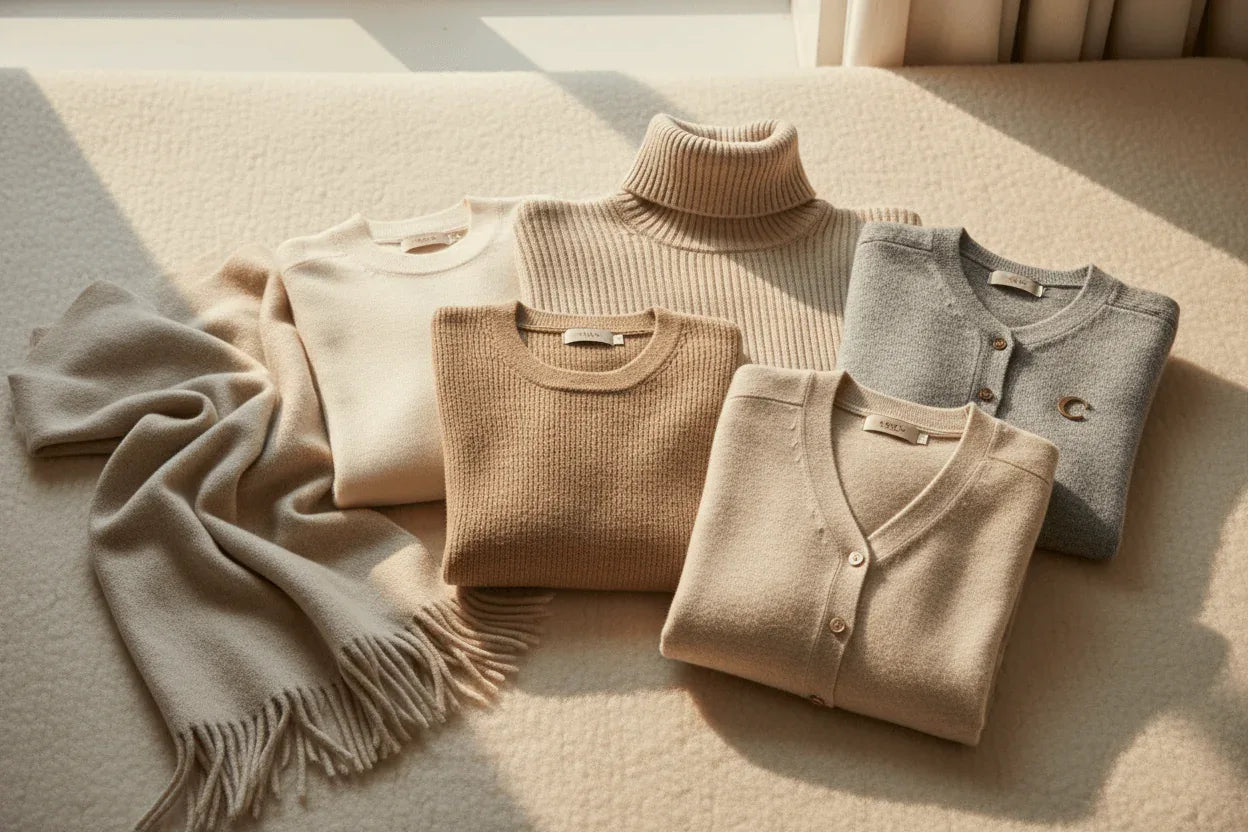


Cashmere vs Merino Wool: Which Is Better for Knitwear?
When shopping for quality knitwear, two fibres come up again and again: cashmere and merino wool. Both are natural, refined and beloved by fashion insiders: but they are not the same. Understanding the differences between cashmere and merino wool can help you choose the right piece for your lifestyle, your climate and your budget.
Here is an honest, side-by-side comparison of two of the finest fibres in knitwear.
Explore knitwear from ELNOVE
Shop the knitwear.
Quick Comparison: Cashmere vs Merino at a Glance
| Feature | Cashmere | Merino Wool |
|---|---|---|
| Softness | Extremely soft (14-19 microns) | Very soft (17-24 microns) |
| Warmth | 3x warmer than sheep wool | Excellent + temperature regulation |
| Durability | Delicate, needs care | Resilient, bounces back |
| Pilling | More prone | Less prone |
| Weight | Lighter, great for layering | Slightly heavier, more structured |
| Price | 2-4x more expensive | Better value |
| Sustainability | Overgrazing concerns | Lower environmental impact |
| Best for | Special occasions, indoor | Everyday, travel, active |
Where They Come From
Cashmere is harvested from the soft undercoat of cashmere goats, primarily raised in Mongolia, China and parts of Central Asia. Each goat produces only about 150 grams of usable fibre per year, which is why cashmere is rare and commands a premium price.
Merino wool comes from merino sheep, originally bred in Spain but now raised primarily in Australia and New Zealand. Merino sheep produce significantly more fibre per animal, making it more abundant and accessible: though high-grade merino is still considered a premium material.
Softness and Feel
This is where cashmere has traditionally held the crown. Cashmere fibres are extremely fine: typically 14 to 19 microns in diameter: giving them that unmistakable buttery softness against the skin. It is the fibre you reach for when comfort is the top priority.
Merino wool fibres range from about 17 to 24 microns. Superfine merino (under 18 microns) comes remarkably close to cashmere in softness, and some people genuinely cannot tell the difference in a blind touch test. Standard merino is slightly less silky but still far softer than regular wool.
Warmth and Insulation
Both fibres are excellent insulators, but they work differently:
- Cashmere is roughly three times more insulating than sheep's wool by weight. It traps air in its fine fibres, creating a lightweight layer of warmth. This makes it ideal for slim-fitting sweaters that keep you warm without bulk.
- Merino wool is also highly insulating and has the added advantage of being better at regulating temperature. Merino actively wicks moisture away from the body, so it keeps you warm in the cold and cool when temperatures rise. It is the more versatile choice for variable climates.
Durability and Longevity
This is where merino wool pulls ahead. Merino fibres are naturally more resilient and elastic than cashmere. They bounce back from stretching, resist wrinkles and hold their shape through repeated wear.
Cashmere, while exquisitely soft, is more delicate. It is more prone to pilling, especially in areas of friction like the underarms and sides. With careful maintenance: hand washing, proper storage and occasional de-pilling: a quality cashmere sweater can last for decades. But it does require more attention than merino.
Pilling
All natural fibres pill to some degree, but cashmere is particularly susceptible. The short, fine fibres that make cashmere so soft also make it more likely to form those small surface balls with wear. Higher-quality cashmere (longer staple fibres, tighter knit gauge) pills less, but it is rarely avoidable entirely.
Merino wool pills less than cashmere, especially when tightly knit. If low maintenance is important to you, merino is the more forgiving choice.
Weight and Versatility
Cashmere is lighter by volume, making it perfect for layering. A cashmere cardigan slips effortlessly under a coat without adding bulk. It also drapes beautifully, giving garments an elegant, fluid silhouette.
Merino wool is slightly heavier but more structurally versatile. It can be knitted into everything from fine-gauge dress sweaters to chunky cable knits, and it holds its shape better in structured designs. It is also more resistant to odour, which makes it a favourite for travel wardrobes.
Price
Cashmere is significantly more expensive than merino wool: typically two to four times the price for comparable garments. This premium reflects the scarcity of the fibre and the labour-intensive harvesting process.
Merino offers outstanding quality at a more accessible price point. For everyday style, it is arguably the better value. For specific pieces at an accessible price point, see our quiet luxury knitwear under £200 guide.
Sustainability
Both fibres are natural, biodegradable and renewable. However, cashmere production has come under environmental scrutiny due to overgrazing by cashmere goats, which has contributed to desertification in parts of Mongolia and China.
Merino wool production generally has a lower environmental impact, particularly when sourced from farms with responsible land management practices. Both fibres last much longer than synthetic alternatives, reducing the need for frequent replacement.
How Each Fibre Responds to Washing and Wear
The durability comparison between cashmere and merino is not simply about which fibre is stronger. It is about which one fails in more manageable ways.
Cashmere degrades primarily through pilling in the first season of wear. The fine, short fibres of the cashmere goat's undercoat migrate to the surface during wear and form pills at friction points: under the arm, at the forearm, and at the collar edge. This is accelerated by washing in warm water or by machine agitation. After the first season, a well-maintained cashmere piece pills considerably less as the loose surface fibres shed naturally. The core fibre is durable if it is not stressed by heat or mechanical agitation.
Merino degrades through gradual thinning over time. Merino fibres are longer and more resilient than cashmere, which gives the fabric better resistance to pilling in the short term. Under repeated washing, however, merino thins at high-friction areas: the elbows, under the arms, and at the collar edge. A merino sweater washed weekly for five years will show some translucency at these points even if it still looks intact from the front.
Both fibres are genuinely long-lived when handled correctly. The practical difference is that cashmere requires careful handling every time, while merino forgives minor care lapses but accrues wear over time regardless of treatment. Cashmere rewards disciplined care. Merino is more forgiving to live with daily.
For practical care instructions covering both fibres, read our guide on how to wash knit sweaters without ruining them and how to store knitwear between seasons.
Gauge and Construction: How the Fibres Behave Differently
How cashmere and merino feel and perform depends significantly on the knit construction used with each fibre. The comparison between the two is not only a fibre question: it is a construction question as well.
Cashmere is almost exclusively used in fine-gauge constructions. The fibre is too expensive and too delicate for mid-gauge or chunky weights in anything other than low-quality blends. A cashmere sweater is typically a smooth, fluid piece with a refined drape and a soft, even surface. The quality comes from the weight of the fibre and its drape rather than from structural interest in the knit itself. There is no cashmere equivalent of a cable knit or a waffle knit with genuine structural integrity: those constructions require a fibre with more resilience.
Merino wool is used across the full gauge range. Fine-gauge merino sits close to cashmere in terms of weight and drape, but with more surface structure and less of the signature cashmere hand-feel. Mid-gauge merino takes on considerably more character: it holds its shape well in cable and textured constructions, gives clean stitch definition, and retains body heat efficiently. A mid-gauge cable-knit sweater in merino will hold its cables crisply through repeated wearing and washing in a way that cashmere simply cannot.
This means that the construction question often determines the fibre choice before softness or price enter the equation. A cable-knit sweater in a substantial weight is almost always merino or a wool blend. A smooth, fine, luxuriously draped pullover is most likely cashmere. Choosing between them is partly a question of which construction type you want, not only which fibre you prefer.
Specific Use Cases: When to Choose Each
These two fibres are suited to different garment types and different roles in a wardrobe.
Choose cashmere for: a fine-knit crewneck or V-neck worn directly against the skin, a lightweight cardigan for layering in a professional context, a gift for someone who values tactile luxury, and any piece where the drape and hand-feel matter more than structural durability. Cashmere performs best as a refined base-layer piece rather than as an outer layer subject to friction and abrasion.
Choose merino for: a mid-weight cable or textured sweater, anything intended as a regular active-wear layer, pieces that will be washed weekly, and any garment where construction interest matters as much as fibre softness. Merino at a good gauge in a structured construction will hold its shape and character far longer than cashmere under equivalent use conditions.
There is a third consideration worth naming: price per wear. A merino sweater at thirty pounds, worn one hundred times, costs thirty pence per wear. A cashmere sweater at one hundred and fifty pounds, worn one hundred times, costs one pound fifty per wear. Both are reasonable for a piece that lasts years. The cost-per-wear logic only breaks down if the cashmere piece is treated as too precious to wear regularly. A cashmere sweater that sits in a drawer is not an investment; it is an expensive object gathering cedar dust.
Frequently Asked Questions
Is cashmere worth the price compared to merino?
For a fine-knit layer worn close to the skin, cashmere is worth it if you will wear it consistently and care for it correctly. The hand-feel difference is real and significant: cashmere's softness is not matched by merino at equivalent weight. If you want a mid-gauge textured sweater you plan to wear heavily and wash often, merino is the better investment at any price point.
Can you machine wash cashmere?
Most cashmere should not be machine washed, but a cold delicate cycle in a mesh bag is survivable for most pieces if you use a wool-safe detergent and keep spin speeds low. The risk is irreversible felting or distortion. Hand washing in cold water takes five minutes and removes that risk entirely. For cashmere specifically, hand washing is worth the time.
Which is warmer, cashmere or merino?
Cashmere is warmer weight-for-weight: the hollow fibre structure of the cashmere undercoat traps heat more efficiently than merino at equivalent gauge. However, a heavier-weight merino piece will outperform a fine-gauge cashmere in cold conditions simply through mass. The warmth question is partly a gauge question: a chunky merino cable knit is warmer than a fine-gauge cashmere piece, regardless of fibre comparison.
What is two-ply or four-ply cashmere?
Ply refers to the number of spun yarns twisted together to make the final yarn. Two-ply cashmere is more durable and resists pilling better than single-ply: the twist between the plied yarns locks the surface fibres in place. Four-ply is heavier and more structured, occasionally used in cashmere-blend cable knits. Single-ply cashmere at a low price point is the most likely candidate for rapid pilling and early failure.
So Which Should You Choose?
There is no single right answer: it depends on what matters most to you:
- Choose cashmere if you prioritise supreme softness, lightweight warmth and a luxurious feel for special occasions or indoor layering.
- Choose merino wool if you want durability, temperature regulation, easy care and versatility for everyday wear across seasons.
- Choose a blend if you want the best of both worlds. Cashmere-merino blends offer the softness of cashmere with the resilience of merino at a mid-range price.
Browse our sweater collection to explore pieces crafted from premium natural fibres: designed to feel as good on your tenth wear as your first.
Explore the ELNOVÉ collection
Shop SweatersRelated Reading
Natural Fiber vs. Synthetic Knitwear: Why It Matters More Than You Think
What Makes Luxury Knitwear Different: A Guide to Yarn, Fabric and Quality
Shop Related Styles
- Joséphine Cable-Knit Turtleneck Sweater
- Margaux Button-Front Knit Cardigan
- Sophie Cable-Knit Crewneck Sweater
- Chambord Stand-Collar Merino Sweater


